
Batch Withdrawals and the Accelerator: When One Confirmation Holds Up a Farm
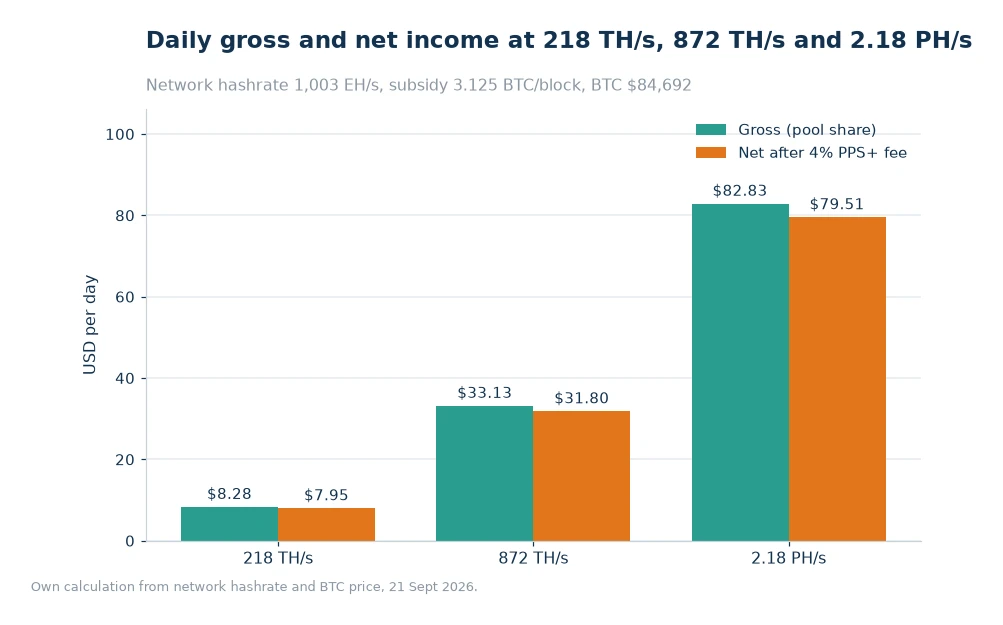
A farm that sweeps every machine's credit into one weekly transfer saves accounting work and builds a heavy transaction. At 218 TH/s, one day of production is 0.00009780 BTC, about $8.28 before the listed 4%; fold thirty of those days together and the batch is 0.00293400 BTC. The size of the payment is not what slows it down, though. The number of separate coins it spends is.

Key takeaways
- One weekly sweep at 218 TH/s carries 0.00068460 BTC and pays $57.98 at $84,692, but its byte size grows with the number of coins it spends.
- The free accelerator lane admits transactions of 0.5 KB or less, so consolidation history matters more than the amount moved.
- At 0.0001 BTC/KB, a transaction at the 0.5 KB ceiling needs at least 0.00005 BTC in fee to qualify.
- Inputs that are themselves unconfirmed block an acceleration; the earlier transaction has to settle first.
Why a farm's withdrawal is heavier than a home miner's
Payouts arrive as separate amounts, each one a spendable output tied to a particular settlement. A home miner with one machine may collect a handful of these before withdrawing. A farm running dozens of units, or a wallet that has received many small transfers over months, collects far more. When all of them are spent in a single transaction, every one of those outputs has to be referenced, and the transaction grows with each reference.
That is the whole mechanism behind the size gate. The amount in BTC can be tiny and the transaction can still be large, because size scales with inputs rather than with value. Operators who have never looked at a raw transaction are often surprised that a $20 sweep fails the 0.5 KB test while a $2,000 withdrawal built from two outputs passes it comfortably.
Merging coins is a decision, not a chore
There are two ways to keep a wallet tidy. The first is to consolidate often, spending many small outputs into one larger one while fees are cheap and the queue is short. The second is to leave everything alone and accept that the eventual sweep will be heavy. Both are defensible, but they lead to different experiences at the accelerator, and the choice should be made deliberately rather than by default.
Frequent consolidation has a cost in fees and in exposure to a bad moment in the mempool. Infrequent consolidation concentrates all of that risk into one large transaction that may not fit the free lane at all. A middle path works well for many small farms: sweep each machine's credit monthly, keep the sweeps modest in input count, and reserve a single annual tidy-up for the leftovers. The Profit Calculator is the right place to check what the mining side produces before deciding how much housekeeping the fee budget can absorb.
When a sweep does stall, the decision to escalate belongs with the same person who scheduled it. The ViaBTC TX Accelerator takes a transaction ID and a fee payment rather than a wallet password, so it never reaches into the farm's balances. That separation is useful in an operation with shared credentials: a shift lead can prepare the request, and the owner can approve the spend without handing over anything more than the hash of an already-built transaction. Keep the approval in writing, even if it is a single line in a shift log, so the cost can be matched later against the batch it freed.
What a day of production looks like at three sizes
The table fixes the hashrate at 218 TH/s and stretches the batch window. It is deliberately dull arithmetic, because the point is that waiting longer makes each withdrawal bigger without making it cheaper to move in the accelerator's terms.
Two habits that keep a batch small
The first is to sweep per group rather than per farm. If twelve machines feed one wallet, sweeping each machine's credit separately produces twelve moderate transactions instead of one heavy one, and each of those can clear the free lane on its own. The accounting is slightly more work and the on-chain footprint is larger, but the rescue path stays open.
The second is to stop generating dust. Small credits that are never worth moving still add inputs when they are eventually swept, so it is worth setting a floor below which a balance is left alone until it grows. Neither habit changes the coins earned. Both change the shape of the withdrawal, which is the only thing the accelerator actually sees.
| Sweep length | Batch size in BTC | Dollar value | Net of listed rate |
|---|---|---|---|
| 1 day | 0.00009780 | $8.28 | $7.95 |
| 3 days | 0.00029340 | $24.84 | $23.85 |
| 7 days | 0.00068460 | $57.98 | $55.66 |
| 30 days | 0.00293400 | $248.48 | $238.54 |
The unrecoverable rules worth reading twice
A submitted acceleration is final. There is no cancellation, no refund, and no way to redirect the transaction once the pool has taken it up. The transaction will be placed in the next block the pool mines, whenever that block is found, so the only thing being bought is priority rather than a timestamp. For a farm, that means the decision belongs to whoever controls the withdrawal keys, not to a shift technician who happens to be on duty when the queue backs up.
Double-spends are refused, which is a sensible safeguard and occasionally an inconvenience. So are transactions that spend unconfirmed inputs. A farm that pays a supplier from fresh mining credits and then tries to accelerate the follow-on payment will hit that wall. The sequence has to be respected: confirm the parent, then accelerate the child. Writing the rule into an internal procedure is cheaper than discovering it during a supplier dispute.
Worked example
Here is the fee arithmetic that decides whether the free lane is even available, using the smallest batch in the table.
- Split the daily issuance: 450 BTC across 1,003,000,000 TH/s gives 0.00000044865 per TH/s.
- For 218 TH/s the product is 218 × 0.00000044865 = 0.00009781, written as 0.00009780 after rounding, or 9.78e-05.
- Value: 0.00009780 × 84,692 = $8.28 gross; after the listed 4%, 8.28 × 0.96 = $7.95.
- Seven-day batch: 7 × 0.00009780 = 0.00068460 BTC, or $57.98.
- Free-lane fee floor at the size ceiling: 0.5 KB × 0.0001 BTC/KB = 0.00005 BTC, about $4.23.
- That floor is about 7% of the seven-day batch value, which is why the size of the transaction rather than the size of the balance decides whether the cheap route exists at all.
At 2.18 PH/s, which is 2,180 TH/s, the daily figure is 0.00097796 BTC. The comparison is the useful part. A transaction with many inputs may need more than 0.5 KB, which puts it outside the free lane entirely, and the paid route then has to be weighed against the batch it is freeing. At 218 TH/s a week's output is under $60, so a paid acceleration can consume a meaningful share of it. At 872 TH/s the same week is 0.00273854 BTC, or $231.94, and the same fee is a much smaller slice.
Frequently asked questions
Is a large withdrawal more likely to qualify for free acceleration?
No. The free lane tests the transaction at 0.5 KB or less and 0.0001 BTC/KB or more, and size follows the number of coins spent rather than the BTC amount, so a small sweep from many inputs can fail while a larger one from two inputs passes.
How much fee does the free lane require at the size limit?
At 0.5 KB and 0.0001 BTC/KB the minimum is 0.00005 BTC, roughly $4.23 at $84,692, and a heavier transaction needs proportionally more to hold the same rate.
What happens if one of the batch inputs is still unconfirmed?
The acceleration is refused until that parent transaction confirms, because the tool does not accept transactions built on unconfirmed inputs; settle the earlier payment first, then resubmit.
Set the batch rule before the queue does
Pick a sweep interval and an input ceiling, write both down, and check the resulting transaction's size before it becomes urgent. Seven days at 218 TH/s is 0.00068460 BTC; thirty days is 0.00293400 BTC. If the monthly figure is what you actually need to move, build the withdrawal from fewer, larger outputs so it stays inside the free envelope. The Mining Farms pages describe how hosted operations are organized, and the same discipline about batching applies whether the machines are yours or someone else's.
Sources: ViaBTC accelerator and fee pages for the free-lane gates, quota handling and the listed 4%[1]. Inputs taken on 21 Sep 2026: 1,003 EH/s network hashrate, block subsidy 3.125 BTC, 144 blocks daily, $84,692 per BTC. First published 24 October 2026; every batch figure is derived from those four inputs.